Olive
A health tech platform that centralizes user health data and leverages Epic’s market dominance.


Olive is a health & wellness platform that empowers users to consolidate, control, and analyze their medical, fitness, and wellness data. By seamlessly interfacing with Epic’s MyChart, users can central their medical data and their cross-provider and provider-patient communication alongside their fitness and wellness application data.
Overview
Team
Solo
My Role
Product designer, UX researcher, Product strategist
Tools
Figma, CrowdSignal, Optimal Workshop, Descript
Timeline
December 2022 - July 2023
Problem
Wellbeing is an integral human need. Yet keeping track of symptom, fitness, and mood data and making sense of diagnoses, treatments, and diagnostic tests is time-consuming, cumbersome, and often invasive.
Solution
A health tech platform which allows users to log, track, and analyze their symptoms, wellbeing metrics, and medical device data while allowing them to selectively share their data with their healthcare providers.
Understanding the market
I conducted a competitive analysis to identify business opportunities Olive’s could leverage. My competitive analysis revealed that the the dominant player in the health tech space - by orders of magnitude - is Epic and its MyChart.


MyChart is a tool for patients to access their digital health records from each provider institution. It is not a tool for managing overall health and wellbeing.
Olive’s Differentiation
MyChart's market position is sufficiently strong that direct competition is not feasible. There is, however, an opportunity to lean upon MyChart’s strong position and leverage its 160 million users as Olive’s target user base (MyChart, “Homepage”).
Olive could provide user value as a product which subsumes wearable data, tracks wellbeing metrics, such as fitness, diet, mood, and mental health symptoms, and interfaces easily with MyChart to seamlessly import these metrics.
Impact of Competitive Analysis
Strategic Choice - To target MyChart users as a customer base.
Research Focus - Investigate MyChart users.
Design Decision - UI to be intelligible to those who have used MyChart before.
Understanding the users
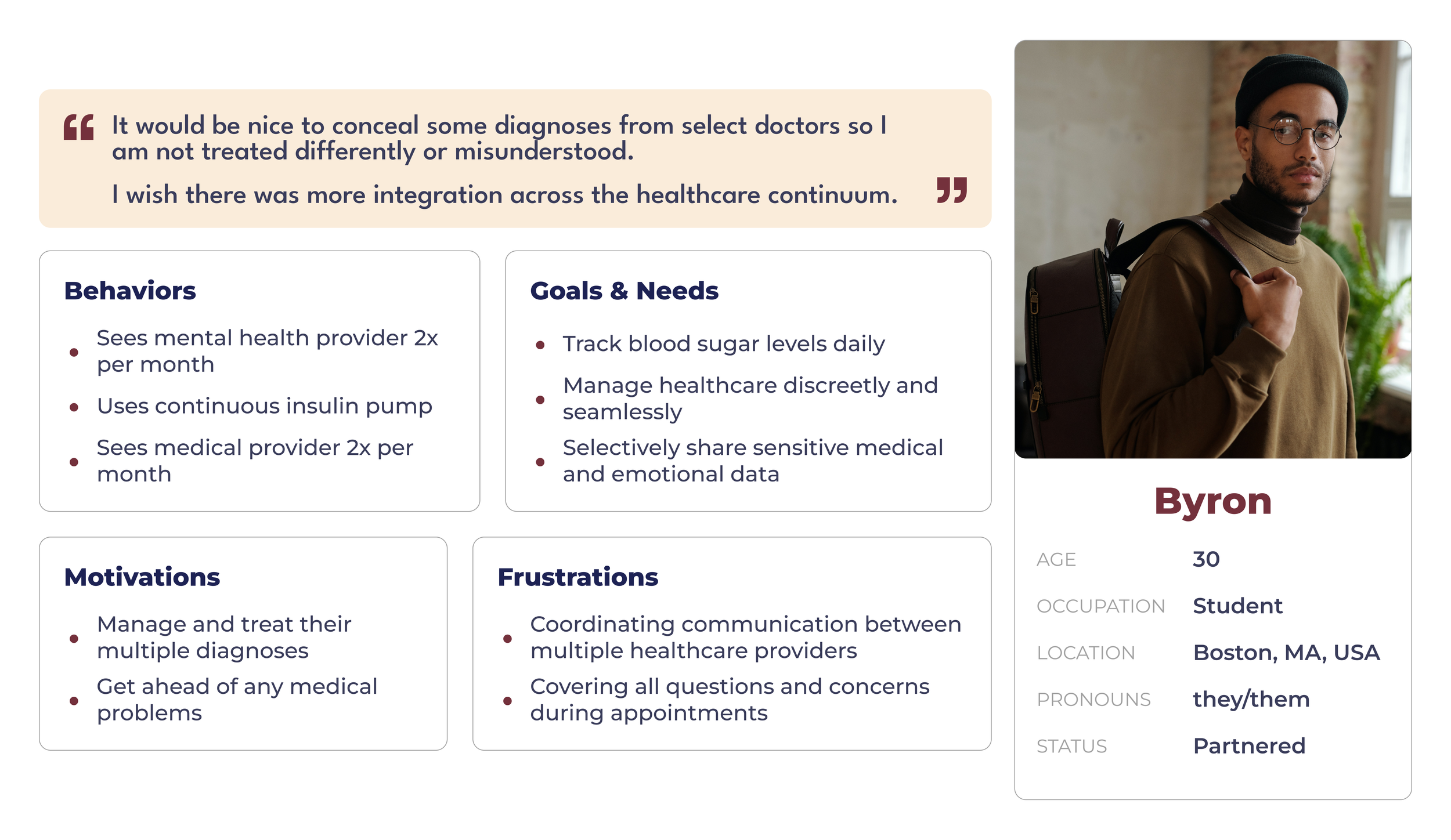
To understand Olive’s target audience, MyChart users, and to identify user problems Olive would need to solve, I conducted a survey and interviews.
My user research objectives were:
Identify which health tech platforms users use, how they interact with these platforms and if participants have any unmet needs or pain points with their current health tech platforms.
Identify user attitudes towards health data protection and consumer tech policy, and their degree of trust in their health tech platforms.
What Users Want
Integration
Users want a centralization of cross-provider and provider-patient communication.
User want to aggregate all of their health, fitness, wellbeing, and medical data.


Users want to communicate to their providers for non-urgent matters and send pre-appointment messages to their providers.
Understand, Analyze, and Control Their Data
Users want to automatically track their health, fitness, wellbeing, and medical data over time and to observe trends through data visualizations.
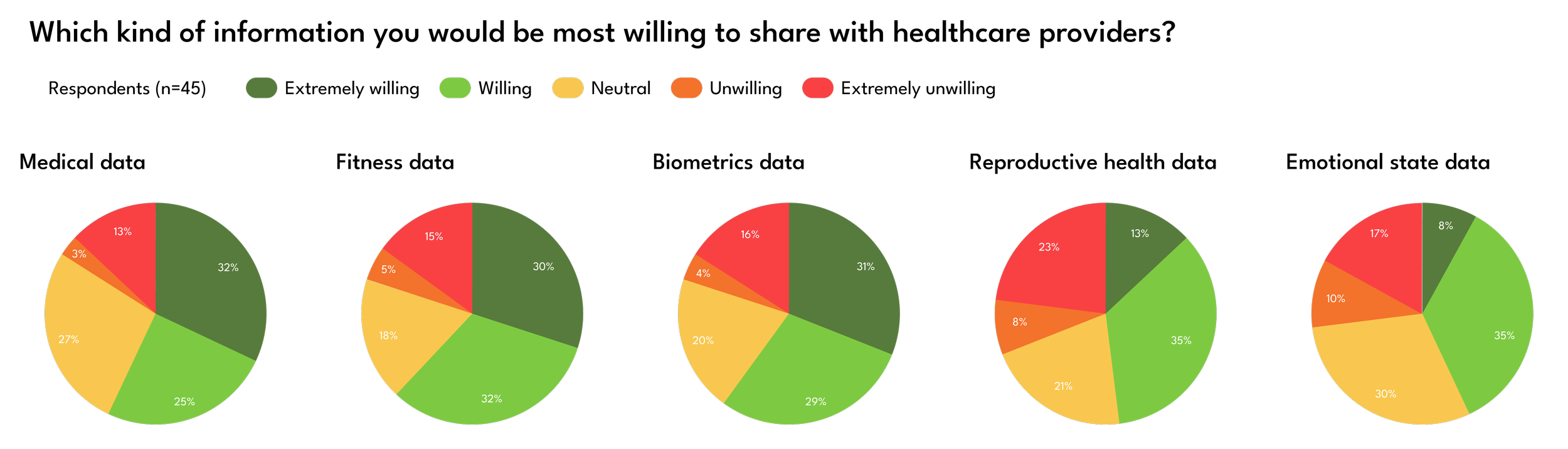
Users are willing to broadly share their data with their healthcare providers, but still want to be selective for more sensitive data.
Users consider mental health and emotional state data more sensitive than fitness data.
Users want their medical tests, like blood panels, explained to them in layman's terms or with easy-to-parse visualizations.
Impact of User Research
Strategic Choice - To display medical data alongside health and other wellbeing data
Design Decision - Olive’s key functions need to be:
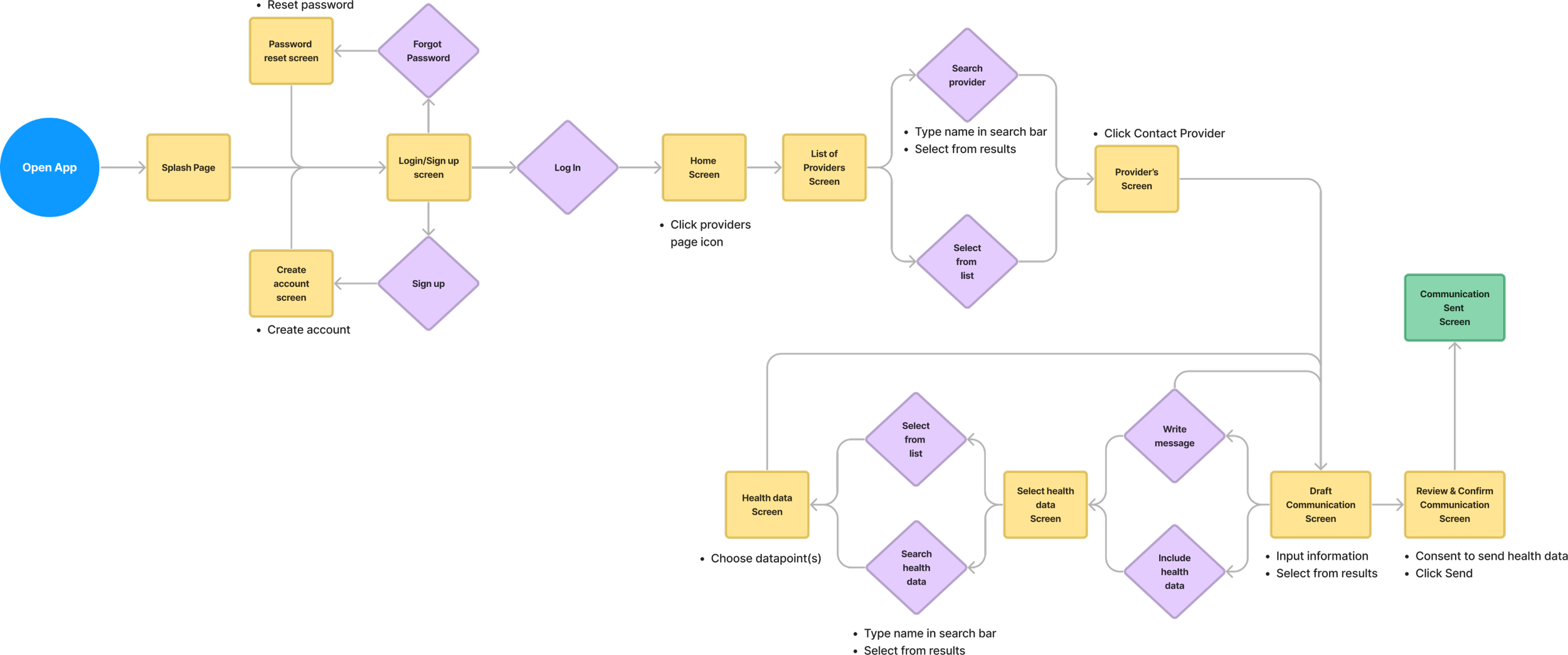
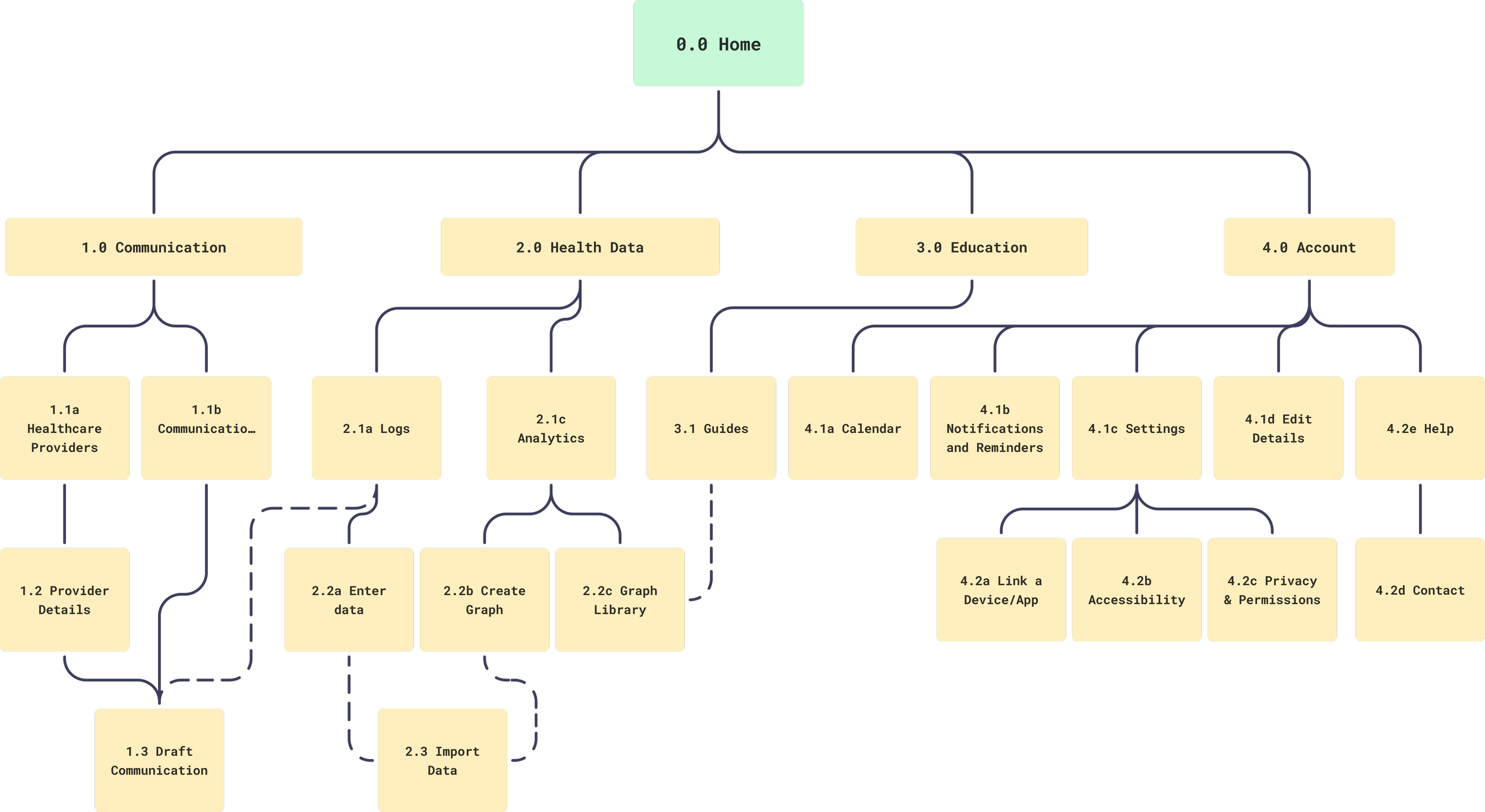
A customizable dashboard which centralizes cross-provider and patient-provider communications, displays upcoming appointments, tracks health routines, and visualizes health data.
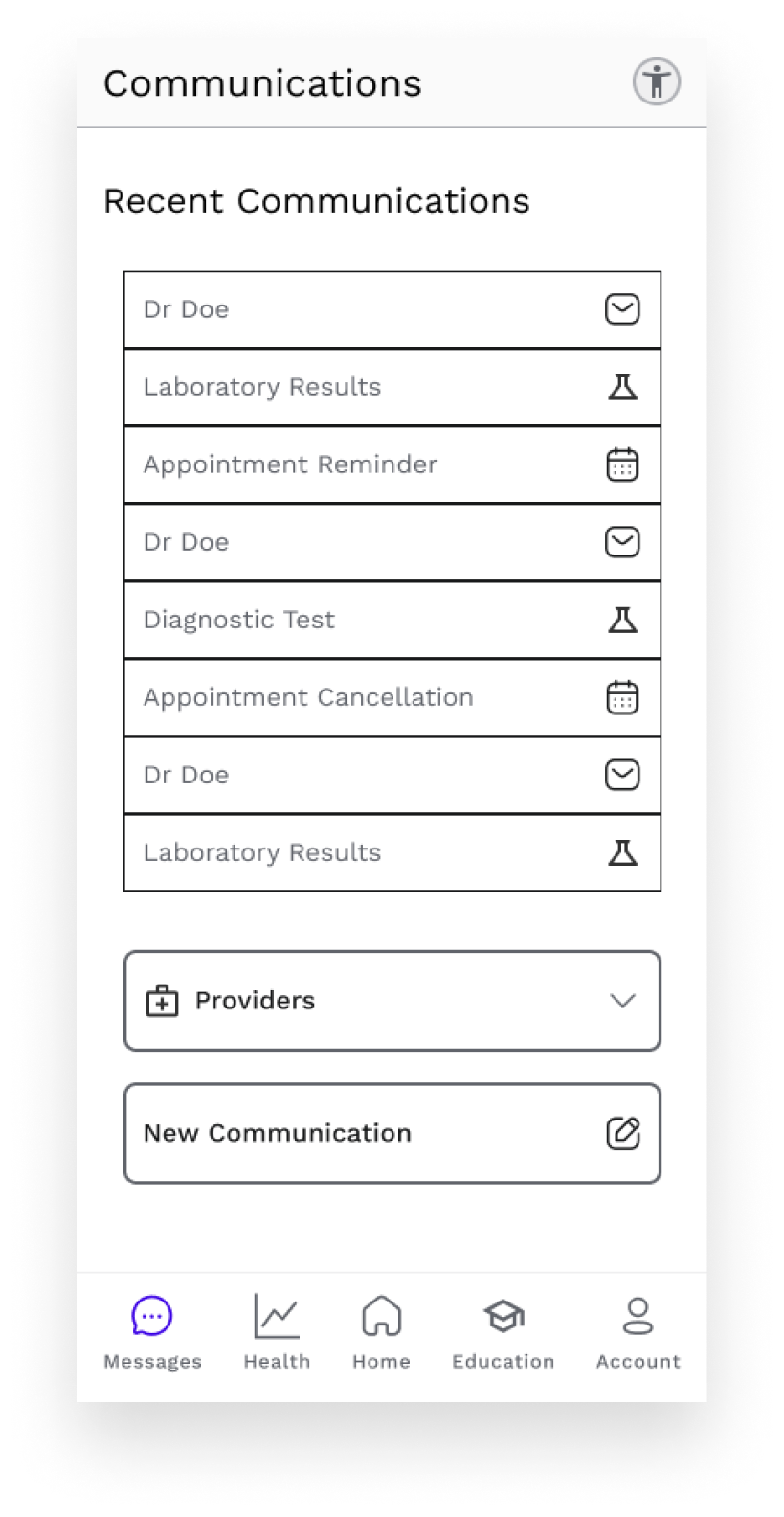
A provider-patient message feature with data selection capabilities and a request for consent to share data.
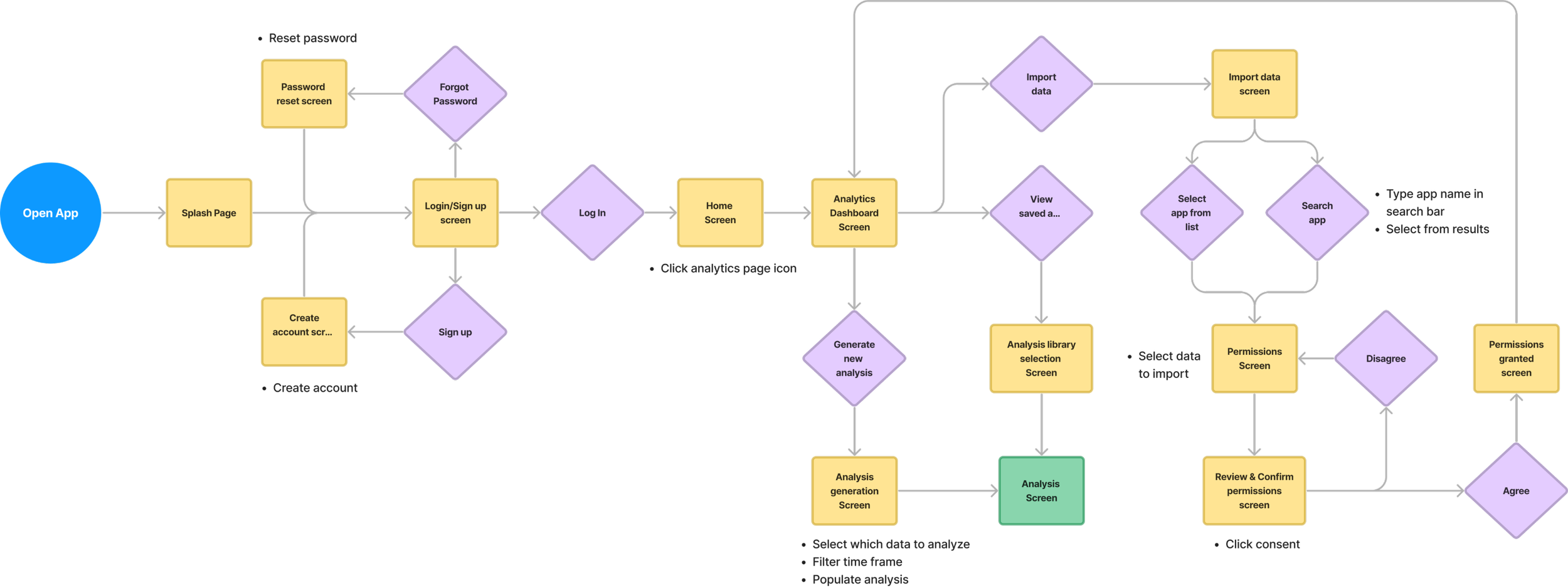
An health data upload feature for various kinds of data to enable record-keeping, sharing with providers, data analysis, and data visualization.
Design Decision - UI and copy must elicit trust, calm, and self-care from the user.
Provider Communication
Designing the solution
Onboarding
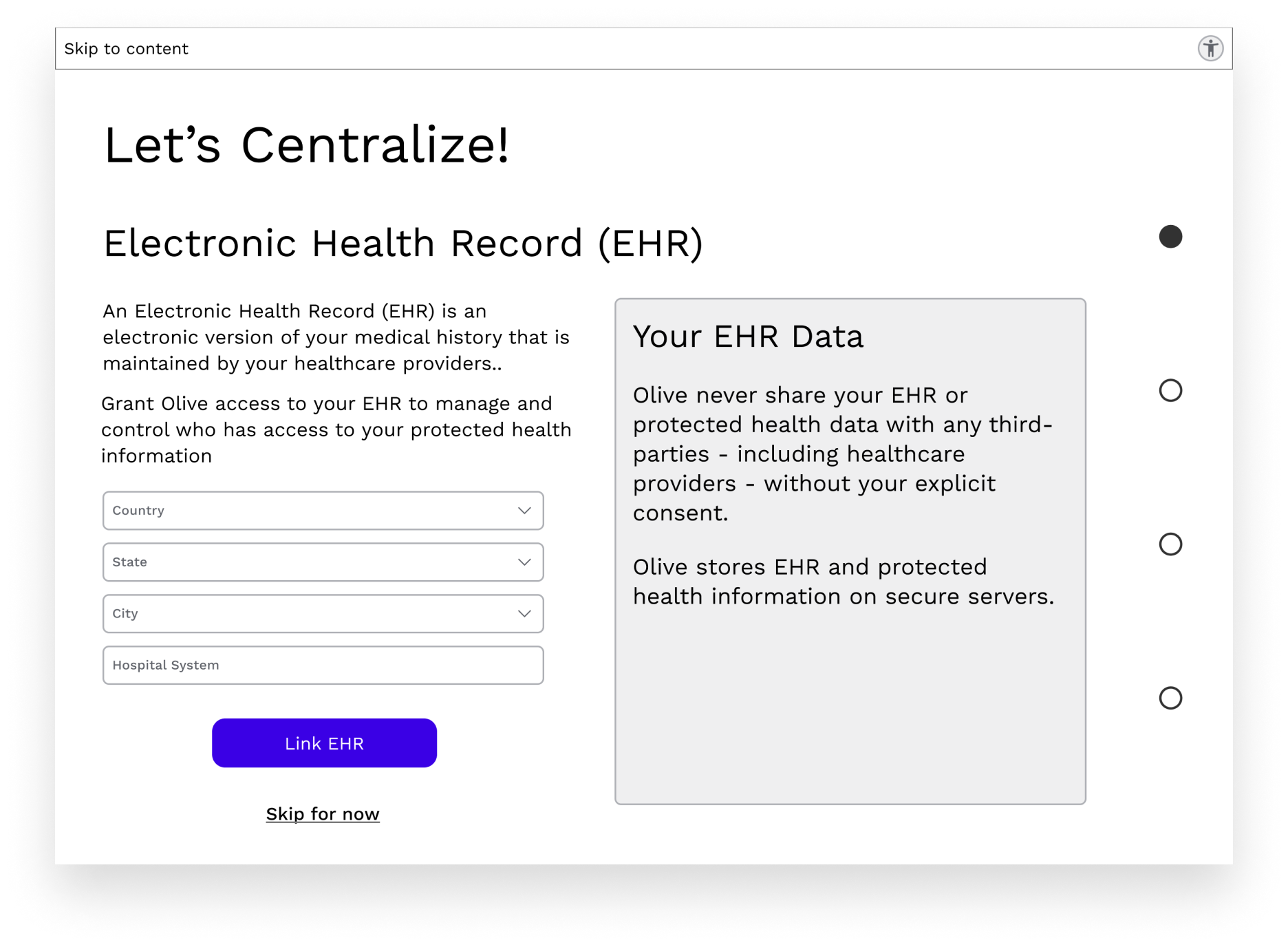
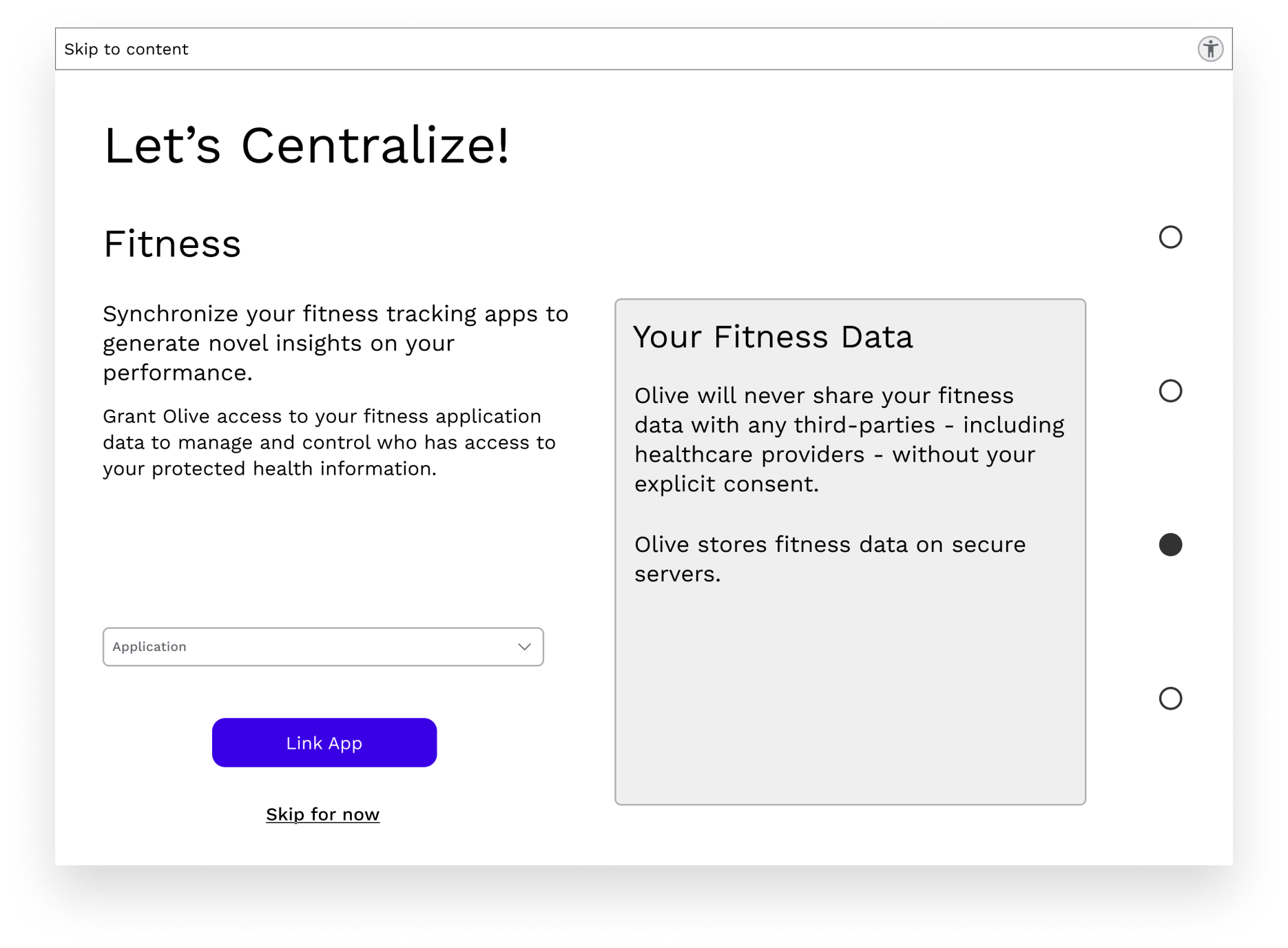
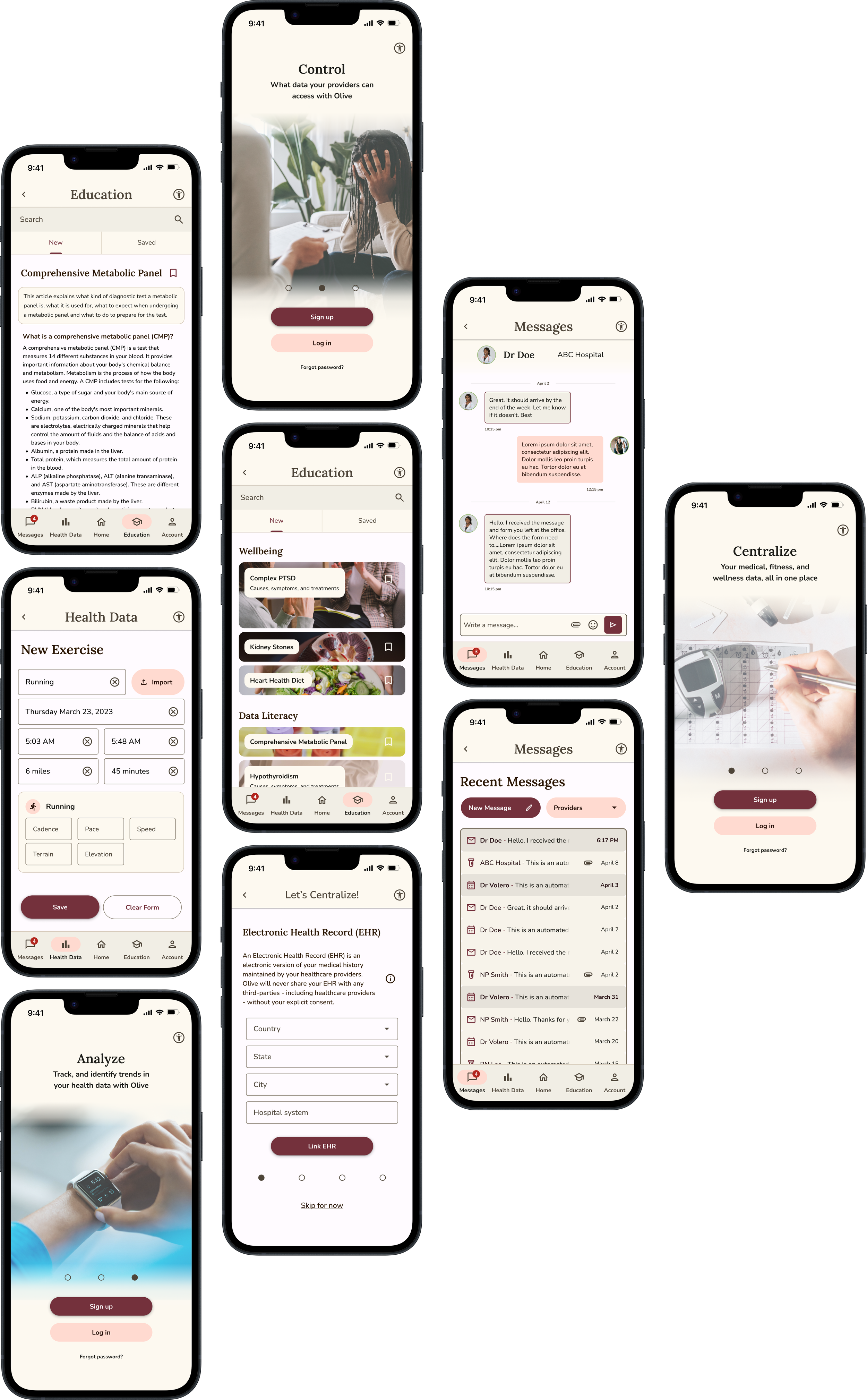
After account creation to demonstrate Olive's value as a centralizing platform, I included four optional data import and third-party platform linking prompts.


Home
Customizable data bubbles to display user health data. Maximum 3 on mobile to accommodate smaller screens.
Tab navigation system as Olive has few yet equally important sections.

Universal symbol for digital accessibility sits in the top bar,
Cards display simple and recent health data, health goal progress, and task status information.
Top tab navigation to leverage user familiarity with MyChart navigation.
Up to 5 customizable data bubbles on desktop.

Slim accessibility bar with "Skip to Content" link for keyboard users.
Uploading exercise data


Sending a message


UI Design
For Olive’s user interface, I studied and drew inspiration from Material Design’s design system.
Color Design
Olive’s color palette was curated to evoke trust, calm, and self-care in its users.
Trust - Getting users to trust Olive with their sensitive and intimate health information necessitates sincerity, wisdom, and competence.
Calm - Stimulating relaxation and thoughtfulness enables users to feel a sense of calm when using Olive to manage often distressing health information.
Self-care - Telegraphing health, wellbeing, and a touch of enjoyment stimulates users to be interested in taking care of their health.
Wine
Secondary
Tertiary
Salmon
92B66C
Neutral
74313C
EB957D
Olivine
Eggshell
F4F1DE
Neutral Variant
Sunset
F2CC8F
Evokes wisdom, responsibility and respectability
(Labrecque & Milne 2012, 714)
Evokes enjoyment and wellbeing (Labrecque & Milne 2012, 714)
Evokes health, calm, wellbeing, and trustworthiness
(Lupton 2017, 107)
Evokes respectability, sincerity, calm, and thoughtfulness
(Labrecque & Milne 2012, 716)
Evokes relaxation, thoughtfulness, wellbeing, and enjoyment
(Lupton 2017, 108)
Primary
Typography
Lora SemiBold, with its serifs and calligraphic references, telegraphs respectability, knowledge, and trustworthiness (Cee 2022; Kastl & Child, 1968).
Modern, sans-serif, Nunito’s rounded letters and curves evoke enjoyment, sincerity, and openness (Cee 2022; Kastl & Child, 1968).






Validating the solution
Usability Testing
I conducted usability tests with the target users to validate my design decisions and to ensure Olive meets users needs.
After each test session, testers completed a 10-point System Usability Scale (SUS) questionnaire. Olive received an average SUS score of 76.7% - meaning that target users found Olive easier to use than 77% of other digital products.
Accessibility Evaluation
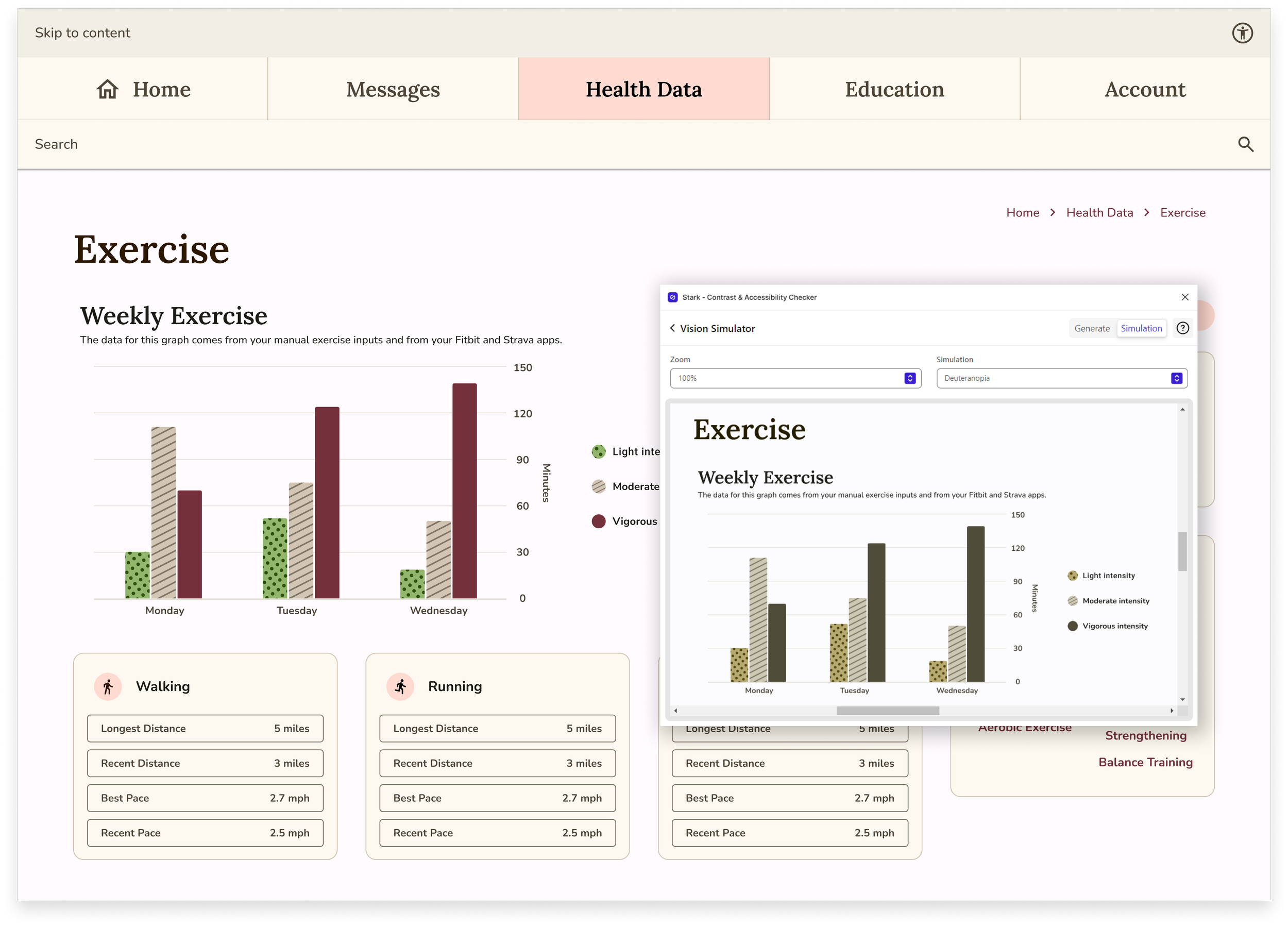
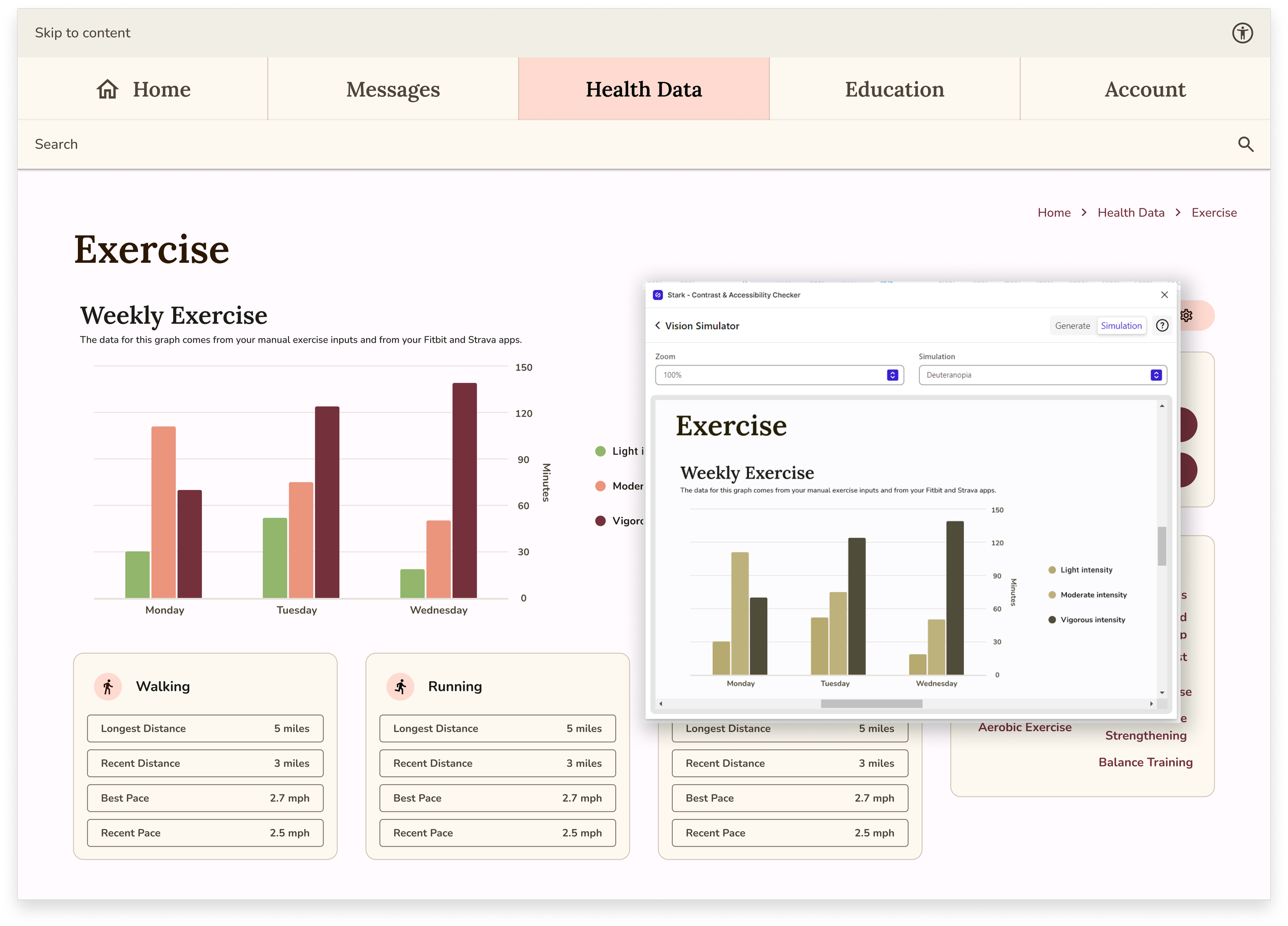
I conducted an accessibility analysis to ensure Olive could be utilized by diverse users. I strove for conformance to Level AAA of Web Content Accessibility Guidelines (WCAG) 2.1. Below is one example of the alterations I made.
Issue
The lines and bars of Olive’s charts were difficult to tell apart, especially for those with deuteranopia.
Resolution
I changed the color of one of the bars from a secondary color tone to a neutral tone, rendering it more discernible for those who easily confuse red and green.
I added texture to a couple of the bars to ensure that color was not the only means of discerning between categories.
“The mobile version feels really nice.”
- User
“Personalized health data bubbles makes it less dull and scary for a health platform.”
- User
Solution
Impact
With Olive, I created a health tech platform that:
Inspires trust, calm, and self-care with its color palette and UI patterns.
Empowers users to control and understand their health and wellbeing.
Leverages a competitor’s market advantage to target 160 million potential customers.
Users found easier to use than 77% of digital products.
What I learned
Tools & Techniques
Researching and designing Olive was the first time I used many of the tools and techniques discussed, including software, such as Figma, Crowdsignal, and Optimal Workshop, as well as frameworks and processes such as user personas, user journeys, user flows, content audits, and site maps. Learning how to navigate new software and conceptualize novel approach while trying to deploy them effectively and efficiently is an immense challenge.
Not only am I now proficient in these software platforms, I have developed confidence in my ability to understand and quickly learn to deploy new methodologies.
Visual Design & Perfectionism
Selecting Olive’s typography and color palette and designing Olive’s UI elements activated my perfectionist impulses. I began overanalyzing the significance and impact of every UI decision, even ultimately inconsequential ones. Olive was an excellent opportunity for me to learn to put into practice the mantra “done is better than perfect”.
Through the visual design process for Olive, I learned more effective techniques of recognizing obsessive over-analysis and how to disengage myself from these patterns.
Feel free to explore Olive’s prototype below

MyChart. “Homepage." 2023, from: https://www.mychart.com/.
Labrecque, L. I. & Milne, G. R., (2012). Exciting red and competent blue: the importance of color in marketing. Journal of the Academy of Marketing Science, 40, 711-727. https://doi.org/10.1007/s11747-010-0245-y
Lupton, Ellen. (2017). Design is Storytelling. Cooper Hewitt, Smithsonian Design Museum.
Kastl, A. J., & Child, I. L. (1968). Emotional meaning of four typographical variables. Journal of Applied Psychology, 52(6, Pt.1), 440–446. https://doi.org/10.1037/h0026506
Cee, Dora (August 4, 2022). Becoming type-sensitive with font psychology. UX Collective, from https://uxdesign.cc/getting-type-sensitive-with-the-psychology-of-fonts-8e8758d70433
Footnotes
Appendix