How do NYC public schools hire teachers?

Investigating the end-to-end hiring process of NYC public school teacher hiring teams and improving their experience.
Overview
Team
UX Researchers, Project Manager
My Role
UX Researcher
Tools
Figma, FigJam, Dovetail, Google Docs
Timeline
May 2025 - September 2025
The New York City Department of Education's Office of Teacher Recruitment & Quality (TRQ) assists principals and assistant principals in their identification, selection, and orientation of new teachers and the retention of existing teachers. TRQ creates hiring resources and manages a resource repository, runs educational webinars, and offers candidate identification services for all New York City public schools.
The TRQ asked our team to investigate the end-to-end hiring process of public school teachers, to identify how hiring teams interact with TRQ resources, and to analyze how TRQ could improve the experience of hiring teams.
Hiring processes for hard-to-staff positions, such as Special Education roles and Multilingual roles, and the application of novel hiring frameworks, such as the Inclusive Teacher Recruitment and Hiring Initiative, were particular areas of focus during the project.
Research Questions
How do hirers of NYC public schools hire teachers, especially for hard-to-fill roles? What are their challenges, pain points, and needs?
1
Do hirers interact with the TRQ’s H.I.R.E. connections website or utilize TRQ materials? If so, how? Do these tools and resources meet hirers’ needs?
2
Understanding the hirers
We decided that a series of virtual focus groups with NYC public schools principals and assistant principals would be the most efficient way to collect the rich qualitative data we would need to understand the hiring process while respecting the busy schedules of our participants.
6 focus group sessions
3 general
3 targeted
Special Education staffing
Multilingual staffing
ITRHI staffing
6 participants
2 principals
4 assistant principals
6 districts
The Bronx
Brooklyn
Manhattan
Queens
Inclusive hiring practices, Special Education hiring, and Multilingual hiring had dedicated focus group sessions as they were areas of specific interest. Focus groups were virtual, lasted between 60-90 minutes and were facilitated and observed by two to three researchers via Zoom. TRQ representatives were present at each focus group session.
Analyzing the data
Transcripts were generated from focus group recordings and anonymized and refined for clarity using Chat GPT. Anonymized and refined transcripts were checked for accuracy against recordings.
Data Processing
Coding - Processed transcripts were uploaded to Dovetail for coding. Two rounds of coding were conducted on the transcripts. One round with descriptive codes, followed by one round of interpretive codes.
Thematic Analysis
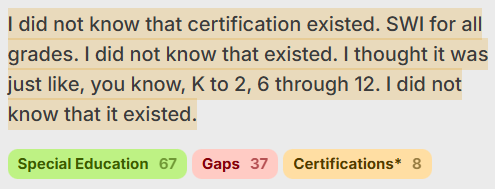
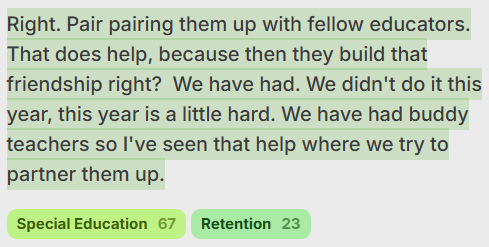
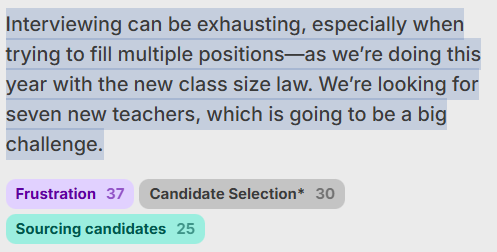
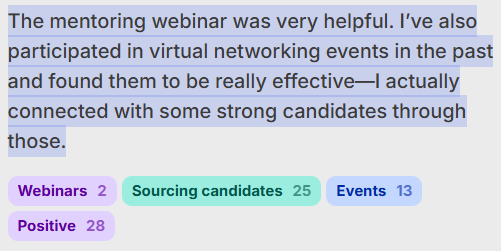
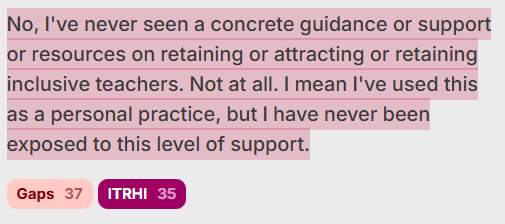
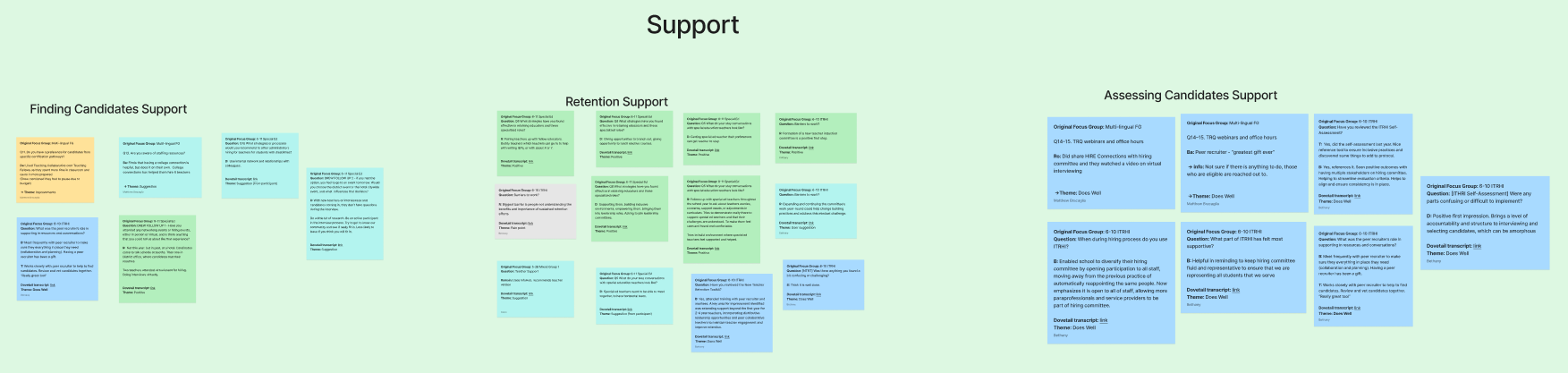
Affinity Mapping - Coded qualitative data were then imported to Figjam for collaborative affinity mapping. What emerged was 5 different themes, with 32 sub-themes.
Synthesizing insights
Inherent complexity
Hiring process is multistep, multifaceted, and nuanced, with numerous pain points. Time scarcity, resource constraints, and specialized challenges for particular roles are compounding challenges.
Reinventing the wheel
Hirers are siloed, they do not communicate frequently with other hirers or share knowledge, leading to each creating their own strategies to hire, onboarding, and retain teachers.
Lack of awareness
Hirers’ use of TRQ resources is low, and with some not even aware of the tools available, especially the H.I.R.E. connections website.

Improving the hiring experience
We delivered eight distinct research reports, each focusing on one theme or sub-theme uncovered during our analysis, and with discrete service design recommendations. Our recommendations to improve the hiring experience for the key stakeholders - hiring teams, candidates, and new hire - include:
Improve outreach
Communication of pertinent policy changes and dissemination of existing TRQ resources to hirers could be improved by adding whole hiring teams and assistant principals to existing principal-only newsletters on teacher recruitment, such as P-Digest.
Encourage knowledge-sharing
Horizontal-communication between hiring teams, such as meet-ups, webinars, and discussion groups, facilitates knowledge transfer and minimizing feelings of overwhelm or lack of support where to turn with questions.
Foster community
Horizontal-, vertical-, geographic-, and certification-networks, such as meet-ups, webinars, and discussion groups, cultivates community and promotes sentiments of belonging in teachers while minimizing feelings of isolation.
Create and maintain resources
Simultaneous recruitment best practice guides, candidate assessment frameworks, and hiring strategies for specialized educations are resources TRQ could develop, maintain, and circulate that would provide hiring teams with structured support across the hiring process. Keep these resources updated, as stale information reduces hiring teams’ trust in TRQ.
Impact of our research
As hiring and retention cycles are years-long, the impact data of our implemented recommendations is being collected. Given currently available data, our model for success includes:
When assistant principals are subscribed to existing principal-only mailing lists for recruitment and retention news, target audience reach can be expected to increase by 103%.
Exponential reach
Multidimensional collaboration
Assuming TRQ creates all the community groups we recommend, we expect administrators and educators to have access to communities across at least 6 dimensions of the NYC DoE organizational network.
Tailored support
If TRQ develops the documents, resources, and service offerings we recommend, administrators and educators will have access to 14 more avenues of specialized support.