The Care Hack
A health & wellbeing platform that supports caregivers of those with cognitive disorders and serious mental illness.


Introduction
I was the sole designer for a B2B2C health tech platform supporting caregivers of those living with cognitive disorders and serious mental illness. The Care Hack provides 24/7 support via expert coaching, psychoeducation, care planning, and wellbeing tracking.
Over six months I designed and shipped user flows and administrator tools across mobile and desktop, as well as introduced design operations practices to govern ideation to handoff.
Understanding the users
With no direct access to users – recruiting a vulnerable clinical population for research was not feasible at an independent early stage startup – so I worked from the domain expertise of the product-leading clinical founder.
User characteristics
As a user base, caregivers of those with cognitive disorders & serious mental illness have these qualities:
- High stress – Caregivers have chronic stress and often experience burnout from the endless responsibility of managing treatment plans, daily needs of another person, financial constraints, and their own wellbeing.
- Low comfort with technology – Many caregivers have limited comfort with digital technologies.
User-centered design
Given the needs of caregivers, all caregiver user flows needed to:
- Support – Minimize cognitive load; use plain language; and employ larger font sizes.
- Inspire – Evoke calm and trust in caregivers, and instill the belief that The Care Hack cares about them.
Designing the solution
Onboarding flow
The onboarding flow had to collect emotionally laden yet clinically necessary information about the loved one’s wellbeing and the caregiver’s own stress levels. Caregivers might be filling out these forms on their phones, in between other demanding tasks or in a vulnerable moment, with little patience for the form.
Simple, direct language, clear visual hierarchy, and only two questions per page on desktop – one on mobile – minimize caregivers’ cognitive load.

Weekly check-in flow
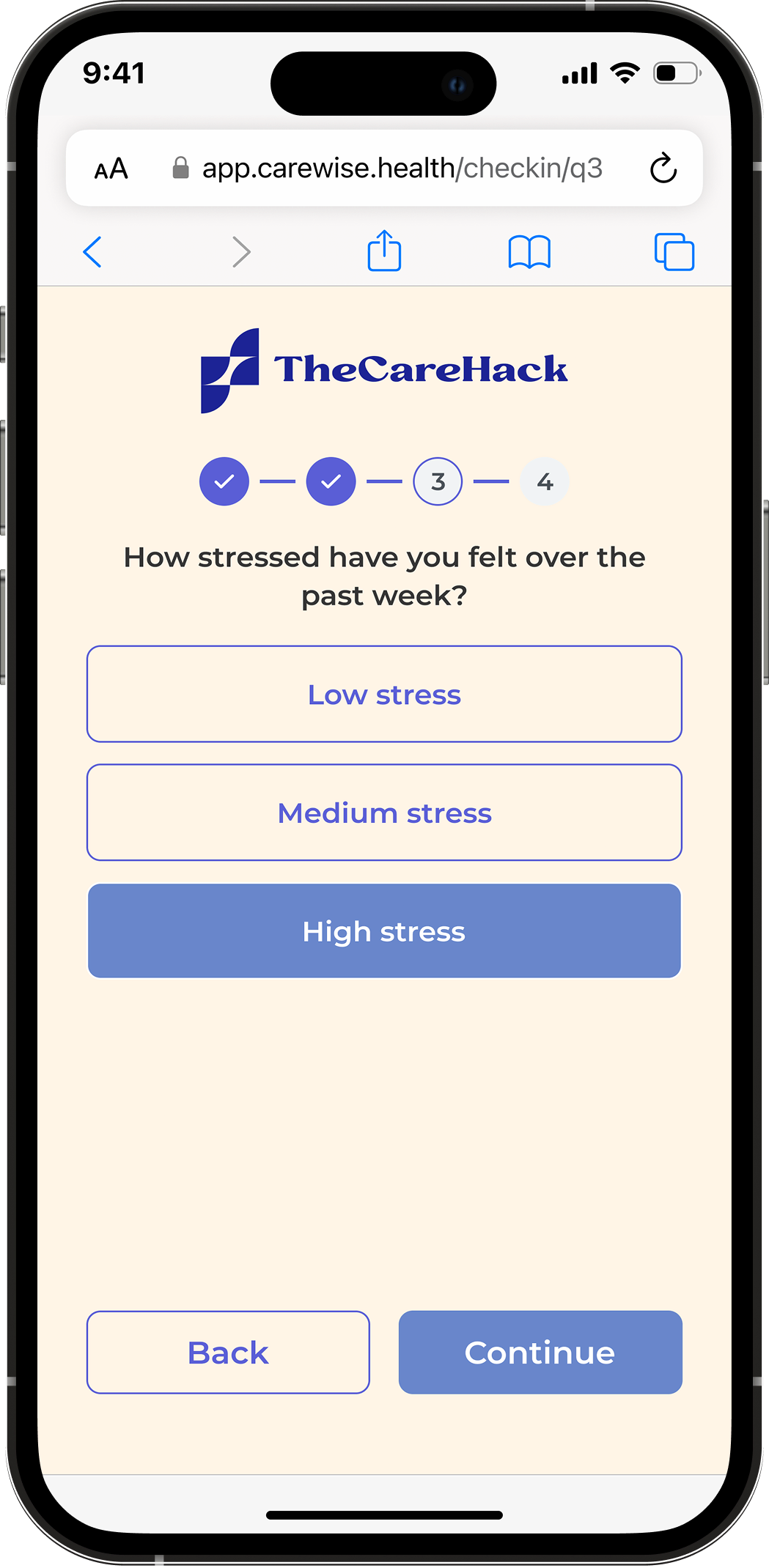
During the weekly check-in, caregivers get a text, open a webpage, and answer a short set of questions about their own mood and their loved one’s wellbeing.
Just like with the onboarding flow, the design is plain, the language is direct, and the palette is soothing to accommodate environmental distractions, user stress, and user technical capabilities.
A confirmation screen with a small success animation sparks positive affect and lightens the load of a repetitive, emotionally loaded task.
Gathering indicators of caregiver and patient wellbeing ought not to be discouraging or burdensome.
Dashboard redesign
The original caregiver dashboard was dense – it was text-heavy, had unnecessarily complex navigation, and lacked adequate proportion in its UI patterns.


My redesign restructured the dashboard and information architecture around caregivers’ priorities. I simplified the navigation design, introduced visual media, and improved visual balance and hierarchy through a bento grid layout.
Chat flow redesign
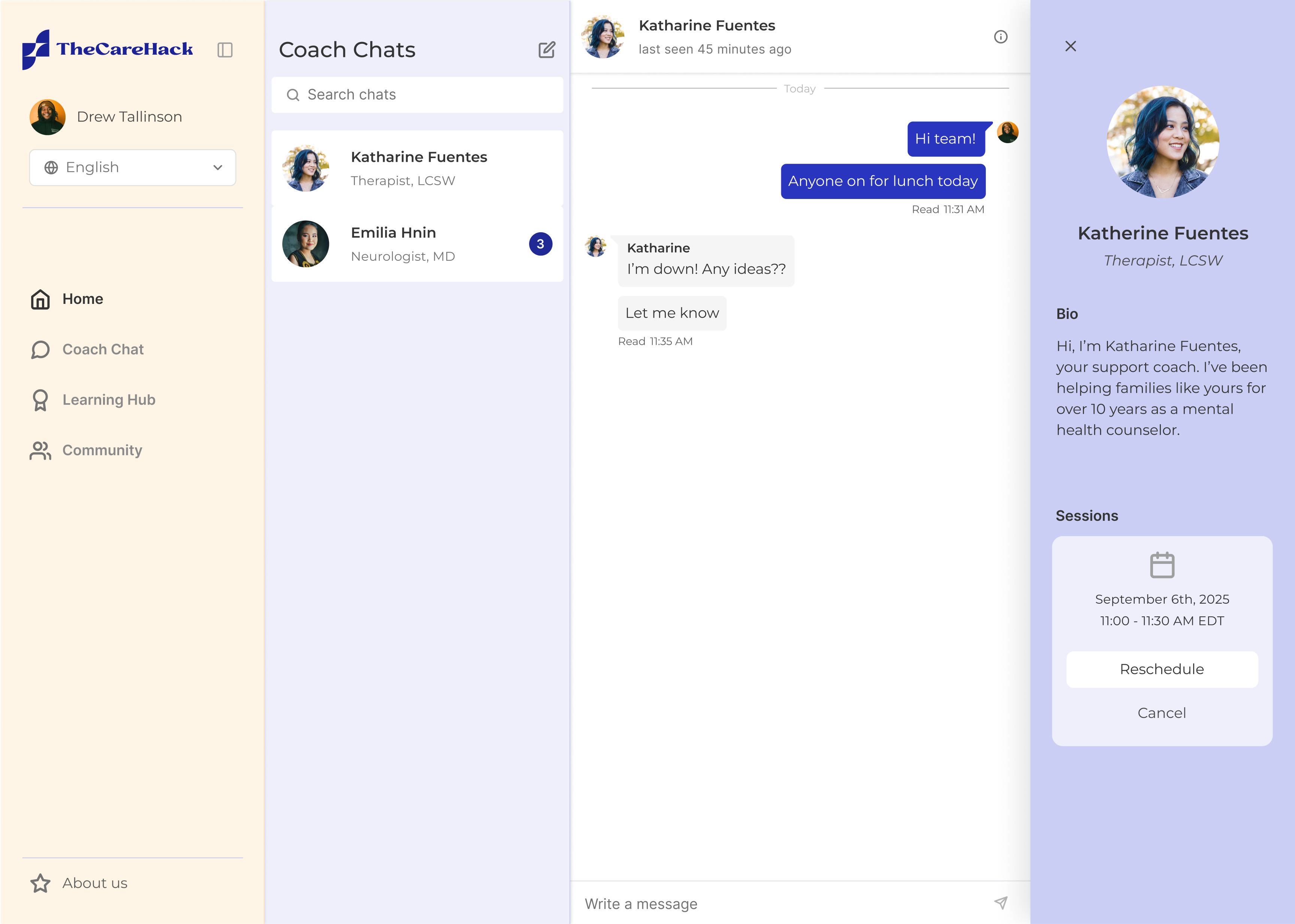
The coach chat is where caregivers connect with experts to receive support in real time.
For new users, an explanatory banner and a clear starting prompt avoid an empty state and orient the user to the chat feature. For a returning user, the most recent conversation lets caregivers pick up where they left off without searching.
For both users, a drawer reveals the coach’s details and background, and allows users to see their upcoming video call appointments with the coach, or to schedule one.


Implementing design ops
Both the chat flow and the dashboard were designed in a week, without any design operations process, handoff procedure, or knowledge of technical limitations as designer-engineer communication had yet to be established. Due to this, the chat flow was never built and the dashboard design fidelity was not maintained when it shipped, as you can see below.

After I established direct contact with the engineering team, I built the design operations structure. I created a design system compatible with the technical architecture, established a handoff procedure and created the accompanying documentation system.
My implementation of design operations procedures ensured the onboarding flow, check-in flow, and all other flows were built as they were designed.

Impact
Over six months at The Care Hack, I:
- Shipped user and administrator flows to clinical partners.
- Designed for trust, calm, and self-care through recognizable UI patterns, simple language, and clear information hierarchy.
- Minimized cognitive load of a user base with chronic stress through user-centered and accessible design.
- Established the team’s design operations practice, including design system, handoff, and documentation.